Showing posts with label East Africa. Show all posts

Monday, 24 September 2012

Walter’s Boda Tours of Kampala

Walter
The best way to see Kampala is by motorbike, or Boda Boda as they are called in Kampala. I was lucky enough to have a brilliant boda driver when I lived here; Walter.

Walter was always on call to ferry the muzungos from place to place and over the six months I spent living in Kampala while on a VSO  placement he became a good friend.

As well as working as a boda he also established Walter’sBoda Boda Tours; using his enthusiasm, intelligence and knowledge of the country to drive and guide tourists around the city.

Kampala on Walter's boda at night
Returning to Uganda this year it was fantastic to see how his business has taken off! Walter now has ten boda guys who work for him and they run a range of tours around the city and beyond to Jinja, Entebbe  or even as far as the equator

I’ve been lucky enough to take a few tours with Walter so far. The city tour is my favourite and takes in the sights such as the Gadaffi Mosque, built in 2006 it’s the second largest mosque in Africa. The views from the top are breathtaking, overlooking the whole city and all the hills with Lake Victoria as the backdrop.

View from the Gaddafi Mosque


From the mosque you can see most of the landmarks the tour takes you to such as the Kings Palace, churches and the Baha’i Temple (although as I lived a few minutes’ walk from this we omitted it from my tour..)

Driving to the Gaddafi Mosque

The tours were a great thing to do when friends came to visit – it make sightseeing much easier and Walter as a guide always puts a smile on everyone’s face.

The King's Palace


Rolex for breakfast
Seeing how fantastically his business has taken off over the past year I was keen to do another tour on my return this time. He runs a great tour of the lake..

Unfortunately due to other commitments on my part I wasn’t able to do the full tour but Walter still made sure I saw as much as possible in the limited time.

We had breakfast at his favourite rolex stand. Rolex is a traditional Uganda/Kampala food of eggs with tomato wrapped in a chapatti – I can’t believe I hadn’t had one until now. It was delicious!

Walter at Lake Victoria 
After helping me with a few errands we drove out to the lake past Munyonyo. It was wonderful to see everyone going about their day to day lives, cleaning vehicles, running businesses and fishing for Nile perch and tilapia.

What a feast we had of a huge fresh tilapia barbecued and served with a large helping of chips and salad.

Finishing lunch just as a big storm hit the lake we raced back to town avoiding as much of the rain as possible and getting me back in plenty of time for my flight home.

Lunch of freshly caught tilapia
Next time I visit I’ll make sure I take the full Lake Tour as I would have loved to sail the boat over to the island and explore further.

For anyone heading to Uganda I’d recommend a day or two in Kampala and give Walter a call on +256791880106 to arrange your tour or visit his website.

Thursday, 20 September 2012

School for Life


Greeted with big smiles at Katuuso Primary School


Arriving at the School for Life school at play time was perfect timing. We were greeted with big smiles from the children and joined in their games of catch and skipping and watched them play the African game of choice, rolling tyres up and down.

One of the 80 children benefiting from School for Life
School for Life is an incredible grass roots organisation set up by a good friend, Dave, and his business partner, Annabelle.

Visiting Katuuso Primary School to see firsthand the impact they are having on the lives of children and the local community was an incredible experience.

Opened in 2011 the school began with one class. The children attending are entitled to their schooling here for free although a 20,000 Shilling (about £5) donation is asked for as a gesture of their commitment and to assist with the running costs of the school. The children here receive outstanding education with the primary class of 40 children having two teachers dedicated to them (class sizes in Uganda are often 70+)

Getting a great education
The class rooms themselves are wonderful and bright; great learning environments for the children and a stark contrast to other African schools I have visited.

Both staff and children are full of smiles as the bell rings and they line up ready to go back to class after playtime.

Currently in the middle of expanding, construction is underway on new class rooms and a library. Every detail of the project is thoroughly thought through; the bricks are all handmade on site which is not only cheaper but also much better for the environment. The construction workers are employed from the local area to give income back into the rural community.

Queuing to go back to class

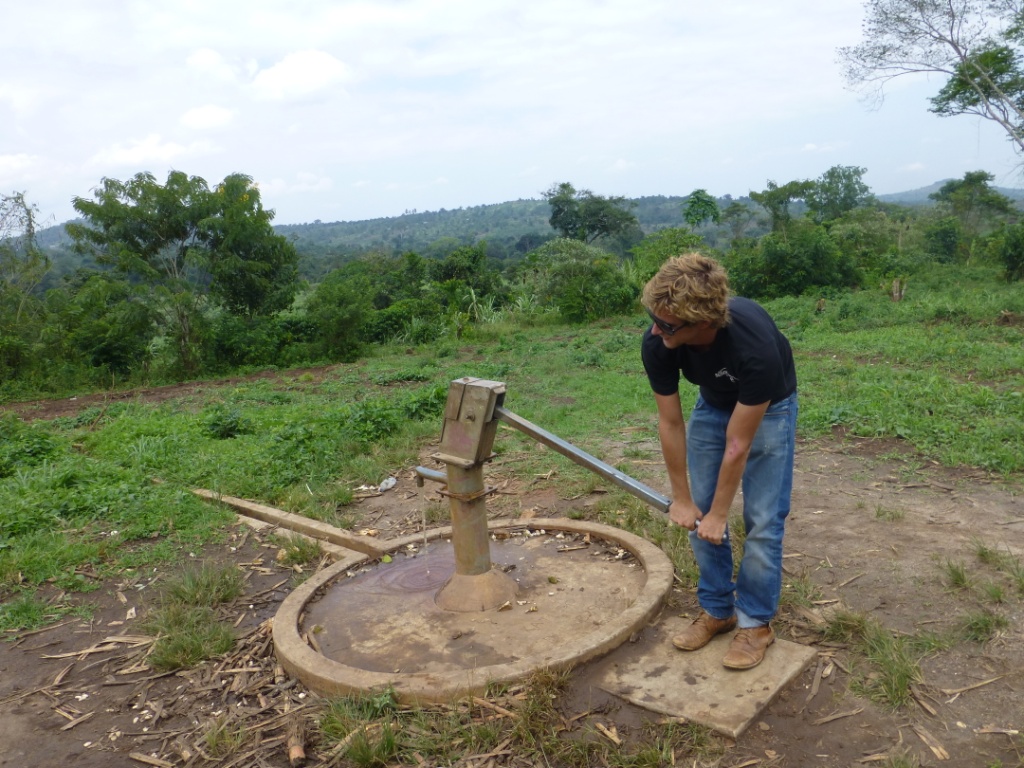
The borehole, one of the first things implemented at the school, is also for the use of the whole community. Providing safe drinking water for the children and their families.

Dave shows us the borehole 


As if this wasn’t enough Dave also showed us the new agricultural plots. Crops of maize, beans, cabbages, etc are peaking our through the red dirt – all planted to assist with the school feeding programme. The children receive breakfast, morning tea and lunch so growing the crops at the school is ideal to provide the food. Cash crops of chillies are growing well and coffee will soon be grown and sold as a further income stream.

Dave showing us the new crops


Great learning environment for the children
I’m so impressed with everything School for Life is doing to support the children in Katuuso Primary and am looking forward to hearing about their expansion plans.

School for Life is an Australian registered charity and relies on donations  to implement its amazing work. Lots of luck to them in their fundraising and in everything they are doing for children in Uganda.


Friday, 14 September 2012

Top tips for climbing Mount Kilimanjaro


Team UNICEF
Having just completed Trek Kilimanjaro for the World’s Children I wanted to share my top tips to make climbing to The Roof of Africa a bit more comfortable...

  • Pack Light
Packing for the trek seemed just as challenging as all the training. Sticking to the strict 15kg weight limit was hard work but when on the mountain I still found I’d brought a bit too much. Don’t worry about extra clothes or a ‘clean’ fleece – everything you wear will stink so just pack one of everything and you’ll be fine.
Also remember that you need to re-pack every night so don’t squeeze everything into your tiny bag as this will be so much harder to do in the small tents at 6:30am every morning..!
  • Let there be light
Light is so important as it gets dark early and trying to pack up your tent with just one head torch can be challenging. I always take small disk lights camping with me and swear by them. They are light and small but those extra rays of light will make all the difference in your little tent
  • Hydrate
It is drummed into you every day of the trek but make sure you drink lots. Everyone’s different in the amount they need to drink, at my tiny 5ft 1 though I still put away at least 4 litres a day. There’s nothing worse than suffering from headaches, tiredness, etc just because you didn’t drink enough.

Drinking from the camelback
A couple of tips I’ve always used in making sure I keep hydrated is to add rehydration salts to my water carrier – it makes the water purification tablets taste a bit better and keeps you on top of hydration.
I always recommend a platypus or camelbak  Having the tube easily accessible makes it so much easier to constantly keep drinking rather than having to stop to take your water bottle out of your bag. It also helps when you’re backs aching from carrying all the water to make yourself drink in order to make your load lighter...!

I bought an insulated tube  for summit day but the tube still froze. I managed to get a litre of water down though as I carried a smaller platypus inside my jacket to prevent it from freezing.
Keeping warm in the tent
  • Keep warm
A hot water bottle was one of the best presents I received before the trek and it made the world of difference in the night.
  • Tidy up
A top tip passed on before the trek was to bring nappy sacks as mini rubbish bags in the tent. Ideal for collecting all the wet wipes, plasters & rubbish in the tents each day.

Trekking in the sunshine
  • Pack for the hot as well as cold
I brought lots of thermals, fleeces a big down jacket, gloves & scarves which were all really useful later on the trek but the first few days were beautifully warm. This was wonderful apart from only having one stay-dry T Shirt. I’d recommend a long sleeved, light weight stay-dry T Shirt for the first few days, this will keep you cool and also protect you from the strong African sunshine. (don’t forget your sun cream!)
  • Enjoy it.
Apart from a few hours trudging up the mountain in the dark on summit day I enjoyed every second of the trek. Go at your own pace; slowly, slowly. Take in the beauty of the country and enjoy the once in a life time experience.


Tuesday, 11 September 2012

How many people does it take to climb Kilimanjaro?


Welcoming the trekkers back to camp each day with song and dance
One of the roles as charity rep on the UNICEF UK treks is to collect the tips for the porters. When the details of the trek were being finalised last year I questioned Across the Divide (the agency who organise our treks) when they stated that there was a $240 compulsory tip in addition to the general ground costs. I thought a tip was optional and I guessed some of the participants would argue the same. I was assured that while the Tanzanian team were paid a fair wage they also rely on their tip money as a source of income and that they would earn every penny of it.


Tents were put up in all weather for our return to camp
As I collected the tips no one gave them begrudgingly and some kindly donated extra. The team looking after us have been unbelievable. From waking us up with a cup of tea in our tents every morning, setting up camp, preparing hot water, carting tables & chairs up the mountain for us to enjoy a civilised breakfast lunch and dinner every day, the list goes on and on...

So how many people does it take to get a group of 26 trekkers and 5 team up the mountain...? 107! We had 86 porters and 2 chief porters who carry all of our kit as well as the ‘essentials’ for the camp. It makes me feel guiltily to think of the heavy jars of jam, tomato sauce, hot chocolate, peanut butter, etc we were tucking into on the mountain.

Lunch time!
The 5 man tent crew not only carried the tents but also ensured they are all put up ready and waiting for us as we staggered into camp each day.
As well as our fantastic cooks, there were also the cooks who cooked for the porters, the med-bag carrier, guides, assistant guides and the list goes on...


Splitting the tips was a challenge as we had to ensure that everyone received a fair amount and that we didn't insult anyone by getting the hierarchy confused.

After much too-ing and fro-ing we got the tip just right, or so we had thought; unfortunately there had been a little confusion with the amount of porters when it came to handing out the tips, but the wonderful participants quickly put their hands in their pockets to make up the deficit and continue to show their gratitude to this awesome team.


Handing out the tips
Everyone is so grateful for the powerful team who were all responsible for making our dreams of standing on The Rood of Africa a reality. We really couldn't have done it without them!